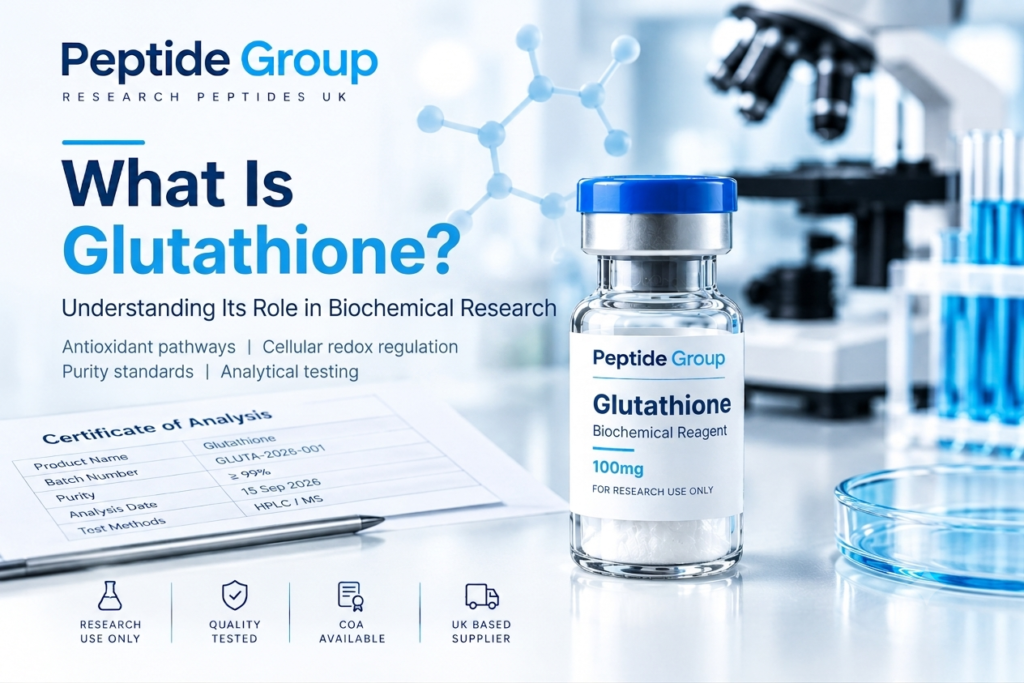
Learn about glutathione's molecular structure, reduced and oxidised forms, redox research, analytical testing and stability.
Introduction
Glutathione is a naturally occurring molecule that plays an important role in cellular redox processes. It is widely studied in biochemistry because it participates in systems that help cells maintain chemical balance and respond to oxidative conditions.
Although glutathione is often discussed alongside research peptides, it is technically a tripeptide composed of three amino acids: glutamate, cysteine and glycine. Its unusual peptide linkage contributes to its distinctive chemical properties.
What Is Glutathione?
Glutathione exists primarily in two forms:
- Reduced glutathione (GSH): The form containing a free thiol group that participates in redox reactions.
- Oxidised glutathione (GSSG): A form created when two glutathione molecules become linked through a disulphide bond.
The relationship between these forms is important in studies of cellular redox balance. Researchers may examine their relative levels to investigate biochemical conditions in particular experimental systems.
Why Is Glutathione Studied?
Glutathione research spans several areas of biochemistry.
Oxidative stress research: Scientists investigate how glutathione participates in reactions involving reactive oxygen species.
Cellular metabolism: Researchers study the molecule’s involvement in biochemical pathways and cellular maintenance.
Redox biology: The balance between reduced and oxidised glutathione can provide information about the chemical environment of a sample.
Analytical chemistry: Laboratory methods can help quantify glutathione or distinguish between its different forms.
The results depend on the sample, the measurement technique and the experimental conditions. Findings from a particular model should not automatically be generalised to other biological systems.
How Is Glutathione Analysed?
Depending on the research question, laboratories may use chromatography, mass spectrometry or other validated analytical techniques.
Sample preparation is particularly important because glutathione’s chemical state may change under certain conditions. Researchers should therefore consider sample handling, storage and the analytical method when interpreting results.
When evaluating a supplied material, review the stated chemical form, concentration or mass content, batch details and available test documentation.
Storage and Handling Considerations
Glutathione stability can depend on environmental conditions and formulation. Follow the material’s technical documentation and appropriate laboratory procedures rather than assuming that every preparation has the same storage requirements.
Use suitable protective equipment and follow the relevant safety data and handling instructions.
Conclusion
Glutathione is an important subject in biochemical research because of its involvement in redox chemistry and cellular processes. Understanding its chemical forms, analytical measurement and stability helps researchers interpret experimental findings more accurately.
Visit the Peptide Group shop to explore the available catalogue and product documentation.
Image alt text: Glutathione laboratory sample vial for biochemical research.