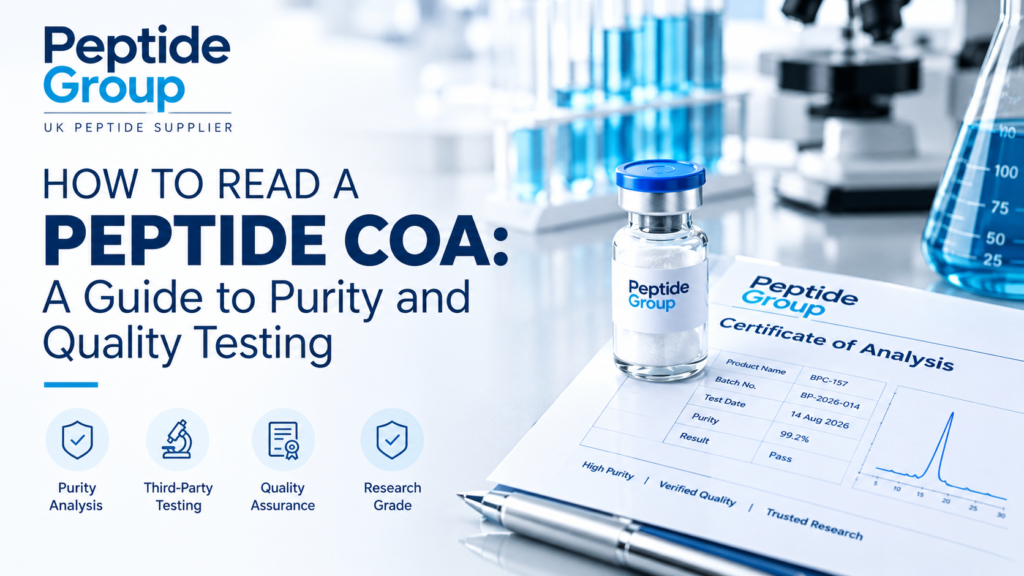
Discover what a peptide Certificate of Analysis (COA) tells you about identity, purity and testing. Learn how to interpret key results and assess laboratory documentation.
What Is a Peptide COA?
A Certificate of Analysis (COA) is a document that records the results of specified tests performed on a material or sample. For peptides, it may include information about identity, chromatographic purity, analytical methods and batch identification.
A COA helps readers understand which characteristics have been assessed and what the reported results indicate. However, not all certificates contain the same tests, and a document should be evaluated according to its scope and supporting evidence.
Understanding how to interpret a COA is important because a high purity percentage alone does not prove molecular identity, establish the absence of every impurity or confirm suitability for a particular application.
1. Check the Peptide Name and Batch Number
Start by checking the peptide name, product reference and batch or lot number. These details help identify the material described in the report.
Where available, compare the information with the associated product documentation. The identifiers should be consistent, and any discrepancy should be clarified before relying on the results.
Batch traceability is particularly important because a laboratory report only provides evidence about the sample that was tested. A valid COA for one batch does not automatically demonstrate the quality of another.
Also look for the report date and the identity of the issuing laboratory or organisation. These details help establish the document’s context and support further verification when necessary.
2. Understand HPLC Purity Results
High-performance liquid chromatography (HPLC) is a technique used to separate components in a sample. During analysis, components pass through a chromatographic column and may separate according to their interactions with the column and mobile phase.
The resulting chromatogram displays peaks corresponding to detected components. Many peptide COAs report purity as a percentage calculated from integrated peak areas.
For example, a report stating 98% HPLC purity generally indicates that approximately 98% of the included chromatographic signal is attributed to the principal peak under the specified method and calculation.
This does not necessarily mean that 98% of the sample’s total mass consists of the intended peptide. Different compounds may produce different detector responses, while some substances may not be adequately detected by the method.
When reviewing an HPLC result, consider:
- The reported purity percentage and how it is calculated.
- The presence of additional peaks in the chromatogram.
- The analytical method and detection conditions.
- Whether the result can reasonably be compared with other reports.
A higher percentage is not automatically proof of better overall quality. Meaningful comparisons require suitable, comparable analytical methods and an understanding of their limitations.
3. What Does Mass Spectrometry Tell You?
Mass spectrometry (MS) measures the mass-to-charge ratios of ions. In peptide analysis, the observed data can be compared with the expected molecular mass to help assess whether the sample is consistent with the intended material.
A close match can support identity assessment, but it does not necessarily establish every aspect of molecular structure. Different substances can sometimes produce similar mass measurements, and additional analytical techniques may be required for more detailed characterisation.
HPLC and mass spectrometry can provide complementary evidence. HPLC helps assess the chromatographic profile, while MS provides mass-related information about detected ions.
When both methods are reported, examine what each result demonstrates rather than assuming that the presence of two tests automatically proves every aspect of quality.
4. Distinguish Purity from Total Peptide Content
Chromatographic purity and total peptide content are different measurements.
A sample may show a high HPLC peak-area percentage while also containing water, residual solvents, counterions or other substances that are not fully represented by the chromatographic calculation.
Consequently, a purity result does not necessarily tell you how much peptide is present by mass. If quantitative content is important, a suitable analytical method may be required.
The appropriate testing depends on the material, the intended assessment and the relevant quality requirements. Not every sample requires the same testing programme, so results should be interpreted in context.
5. Review the Laboratory and Testing Information
A useful COA should make it reasonably clear which sample was tested, which methods were used and who issued the report.
Check whether the document includes sufficient information to understand the results. Where a laboratory is identified, its identity and role may be independently verified. If accreditation is claimed, check whether its scope covers the relevant testing activity.
A laboratory logo or a formal-looking document is not, by itself, proof that the report is genuine. Likewise, missing information is a reason to request clarification rather than automatic proof that the document is invalid.
Where important details are unclear, ask for the complete report or supporting analytical information.
6. Recognise Common COA Warning Signs
Certain issues deserve closer attention when reviewing a Certificate of Analysis:
- Missing or inconsistent batch identifiers.
- No clear description of the analytical methods.
- A purity percentage without sufficient explanation.
- Identity claims unsupported by described analytical results.
- Unclear laboratory details or report dates.
- Results that cannot be linked to the material being assessed.
- Claims that go beyond the tests actually performed.
These signs do not automatically prove a problem, but they indicate where additional information may be needed.
A careful review focuses on traceability, the quality of the available evidence and whether the results support the claims being made.
Frequently Asked Questions
What does COA stand for?
COA stands for Certificate of Analysis. It records the results of specified tests performed on a material or sample.
Does 99% HPLC purity mean a peptide is 99% pure by weight?
No. HPLC purity is often reported as a percentage of integrated chromatographic peak areas. This does not necessarily represent the percentage of the sample’s total mass made up by the intended peptide.
Can mass spectrometry confirm peptide identity?
Mass spectrometry can provide useful evidence by comparing observed mass-related data with expected values. However, additional analytical methods may be needed to investigate structural differences that mass measurements alone cannot resolve.
Does a COA prove that a peptide is safe for human use?
No. A COA only provides evidence about the characteristics and tests it reports. Purity or identity results alone do not establish clinical safety, efficacy, sterility or regulatory authorisation.
Conclusion
Reading a peptide COA involves more than checking the headline purity percentage. Batch identification, analytical methods, identity evidence and testing limitations all influence what can reasonably be concluded.
HPLC can provide information about chromatographic composition, while mass spectrometry can support identity assessment. Clear documentation and traceable sample references help connect these findings to the material being evaluated.
For further information, visit the Peptide Group website and consult the relevant product documentation and quality information available for the material concerned.